
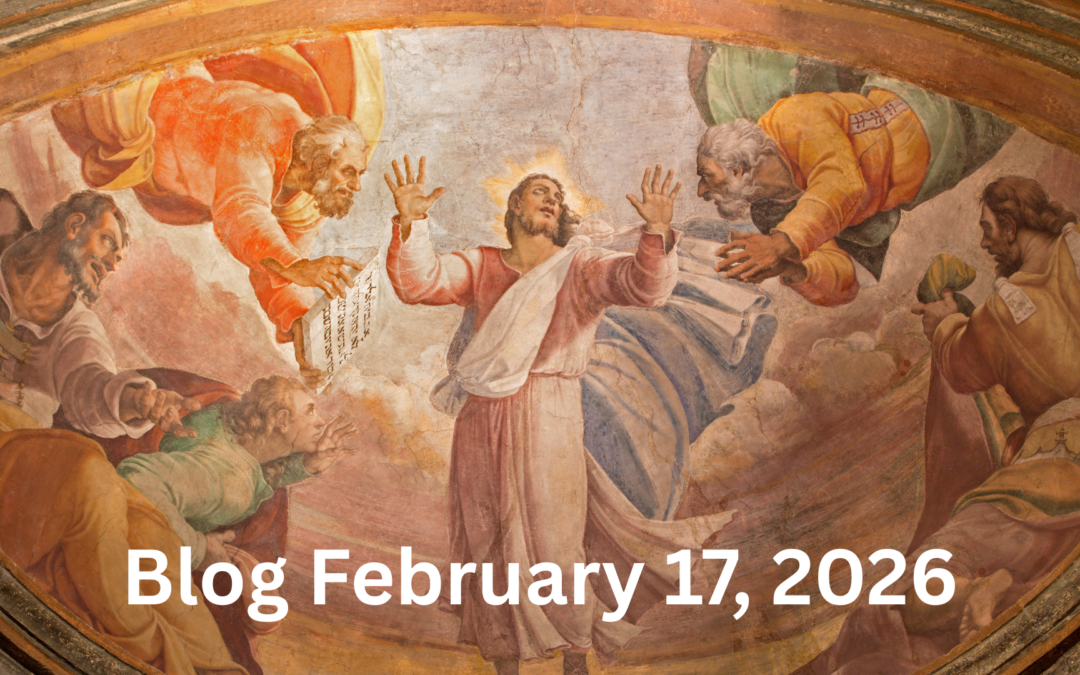
The last Sunday after the Epiphany brings us to the apex of the season of revelation. On a high mountain, the veil is pulled back and the full glory of God the Son blazes forth. But this mountaintop moment is not the destination. It is a signpost pointing forward to the cross and backward through all of redemptive history, confirming that everything God has spoken, He will accomplish.
The Mountain of God’s Presence (Exodus 24:12-18)
Moses ascends Sinai at the Lord’s command, and the mountain is wrapped in the glory of God. For six days the cloud covers it, and on the seventh day the Lord calls to Moses out of the cloud. To the watching Israelites below, the glory of the Lord appeared “like a devouring fire on the top of the mountain” (Exodus 24:17).
This scene establishes patterns the Transfiguration will fulfill and surpass. A chosen servant ascends a mountain. God’s presence descends in a cloud. Divine glory is revealed, terrifying and consuming. And on the mountain, God speaks, giving His Word to His people through a mediator.
Notice what Moses receives: tablets of stone, “the law and the commandment, which I have written for their instruction” (Exodus 24:12). God’s purpose on the mountain is not merely spectacle but revelation. A Word to be heard, received, and obeyed. The giving of the Law is an act of grace: the Creator telling His redeemed people how to live as those He has already delivered from bondage. The Law at Sinai was not the means of their rescue but the shape of their grateful response and the guardrails of their covenant life with God. The God who saves is also the God who instructs, and both actions flow from the same holy love.
The Prophetic Word Confirmed (2 Peter 1:16-21)
Peter writes near the end of his life, and he grounds his final testimony in something he saw: “We did not follow cleverly devised myths when we made known to you the power and coming of our Lord Jesus Christ, but we were eyewitnesses of his majesty” (2 Peter 1:16). He heard the Father’s voice. He saw the Son’s glory.
Yet Peter does something surprising. After establishing his eyewitness credentials, he directs his readers to something even more certain: “And we have the prophetic word more fully confirmed, to which you will do well to pay attention as to a lamp shining in a dark place” (2 Peter 1:19). Peter, who stood on the mountain, says that the written Word of God is more fully confirmed than even his own extraordinary experience. Faith does not rest on subjective experience, mountaintop moments, or emotional intensity. Faith rests on the objective Word of God, which the Holy Spirit inspired and which endures forever.
“No prophecy was ever produced by the will of man, but men spoke from God as they were carried along by the Holy Spirit” (2 Peter 1:21). We do not stand over Scripture, selecting what suits our preferences. We stand under it. We receive it. The prophetic Word is a lamp in a dark place, and we are the ones stumbling in the dark who need its light.
The Son Revealed (Matthew 17:1-9)
Jesus takes Peter, James, and John up a high mountain, “and he was transfigured before them, and his face shone like the sun, and his clothes became white as light” (Matthew 17:2). This is no mere prophet glowing with reflected glory. This is the divine nature of the Son of God breaking through His human flesh; the glory He shared with the Father before the world existed (John 17:5).
Moses and Elijah appear, representing the Law and the Prophets; the entirety of Old Testament revelation. Luke tells us they discussed Christ’s exodus, which He was about to accomplish at Jerusalem (Luke 9:31). Just as Moses led Israel from slavery to freedom, Christ would accomplish a greater Exodus. He, as God’s means, led His people from bondage to sin and death into everlasting life. But this Exodus would be accomplished not by parting waters but by shedding blood.
Peter wants to preserve the moment; glory without the cross. But the Father interrupts: “This is my beloved Son, with whom I am well pleased; listen to him” (Matthew 17:5). God does not place His Son alongside Moses and Elijah as one voice among equals. He silences every other voice and points to Christ alone.
And what has this Son been saying? Take up your cross and follow me (Matthew 16:24). The command to “listen to Him” is not an invitation to passive reception alone but a call to trust His Word, follow His path, and walk in the obedience that flows from faith. When the cloud lifts, the disciples see “no one but Jesus only” (Matthew 17:8). The Law and the Prophets pointed to Christ, and now He stands alone as the final Word of God.
The Transfiguration stands as the hinge between Epiphany and Lent, between glory glimpsed and glory accomplished. Christ does not remain on the mountain. He descends toward the cross. And He calls us to follow, not in despair but in confidence, holding the prophetic Word that is more certain than any experience. His Exodus is our Exodus. United to Him in baptism, His death is our death to sin, and His resurrection is our resurrection to new life. Listen to Him.
Not for our glory, but for His alone.
Jeremy Miller
Church Elder